Ribe domkirke & Riberhus
Niels Lændi/Lendi - 1300, King Erik Menved's rigsråd,was in
1283 and probably still in 1296 Høvedsmand at Riberhus and
was closely connected to Ribe and surroundings. He founded
an altar in Ribe domkirke for his and his father Christiern Lendi's
souls; he had,together with the bishop, to appoint people of
Varde Syssel for ships' business. A son of Niels Lendi was later
bishop in Ribe, but it is also known that he owned Troldorp, a
long disappeared main farm in Sabro herred; one of his daughters
was married to Anders Stigsen Hvide, the famous marsk Stig's
son, and another daughter to Palne Jonsen of Støvring. As the
king's rigsråd Niels Lendi was in 1298 and 1300 forlover (guarant)
of the safe passage letters, which were issued for archbishop
Jens Grand and for the Norwegian king, and in 1307 he sealed
the letter of vasalry for hertug Christoffer on Sønderhalland and
Samsø.He was married to a daughter of Niels Peck or Niels
Kammermester and was probably dead already in 1310.
Kinch, Ribe bys Hist. I, 1, 30, ff.
After Thisets Danish text: grethe bachmannDansk Biografisk Lexicon,
Carl Frederik BrickaProject Runeberg.
Niels Lendi was the ancestor of the Kaas-family with a chevron
in their coat of arms. His son was hr. Jens Nielsen of Kaas.(who
is mentioned 1302-25). His daughter Margrethe Nielsdatter Lendi
was married to Anders Stigsen Hvide of Møllerup. Another
daughter Elne Nielsdatter Lendi of Troldorp was married to Palne
Jonsen Juul of Støvringgård. ( A daughter of Elne and Palne Jonsen
was Lisbeth Palnesdatter Juul, who was married to Niels Bugge
of Hald.)
(Source: P. Filtenborg: Sejer Olesen Leth og hans slægt)
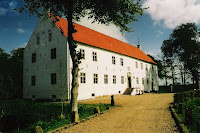 Stårupgård,Højslev sogn,Viborg amt.
Danmarks Adelsårbog:
Kaas, Bjørn *1518, rigsråd, + 26 March 1581 at Bygholm,buried
in Højslev church (Viborg amt) Parents: Niels Kaas of Stårupgård
+ 1534 and Anne Bjørnsdatter Bjørn + 1539. Married 4. November
1554 at Stårupgård to Christence Nielsdatter Rotfeld; she was
buried 19. March 1601 in Bjersø kirke in Skåne, she was a daughter
of Niels Jensen Rotfeld of Bratskov, + earliest 1551, and Anne
Høgsdatter Banner of Eskær, + earliest 1553.
Bjørn Kaas was abroad 1540 and took part in 1548 as a member
of court in Chr. III's daughter Anne's wedding-procession to
Sachsen. After this he was in foreign active service and led
together with his brother Jens Kaas a private feud against the
city Lüneburg. After 1561-63, having been a vasal at Vordingborg
slot, he played a leading role as vasal in Skåne 1564, first at
Hälsingborg 1563-65. As a provisions-master in Skåne together
with Axel Viffert he was hardly free from responsibility of the
bad provisioning, which paralysed the strategy; on the other
hand he wasn't too compromised, since he 1565 replaced
rigshofmester Eiler Hardenberg as vasal at Malmøhus (until 1580),
as which he from time to time received government orders for
the whole province and continuing had considerable
co-responsibility for the army's supply, which seems during the
following years to function quite a lot better.
Together with other leading men in Skåne he summoned up
(several times) Skåne's peasants as a defense against
Swedish attacks and took part in leading a failed peasant
attack on Småland late 1567. In the beginning of the same
year he had been elected rigsråd and immediately after this
he led together with Frands Brockenhus a force to Norway,
where they with a reinforcement from Bergenhus forced the
Swedes to give up the siege of Akershus.
During the next years Bjørn Kaas got more diplomatic
assignments. He took especially a leading part during the
negotiations with Lübeck about the restoration of Bornholm,
which he together with another rigsråd received in the name
of the Danish government 1576. 1580-81 he was a vasal at
Bygholm slot.
Bjørn Kaas was the owner of a large estate. Besides the
family manor Stårupgård (main-building is his work) he had
Vangkær, Kærsgård and Ellinggård in Vendsyssel, Voergård
in Hellum herred, Tybjerggård at Sjælland and Bjersøholm
in Skåne. A part of his riches came from his wife.
Niels Hemmingsen dedicated his work "Livsens vej" to Bjørn
Kaas (1576).
A gravestone with portrait in Højslev kirke.(Viborg amt)
Stårupgård,Højslev sogn,Viborg amt.
Danmarks Adelsårbog:
Kaas, Bjørn *1518, rigsråd, + 26 March 1581 at Bygholm,buried
in Højslev church (Viborg amt) Parents: Niels Kaas of Stårupgård
+ 1534 and Anne Bjørnsdatter Bjørn + 1539. Married 4. November
1554 at Stårupgård to Christence Nielsdatter Rotfeld; she was
buried 19. March 1601 in Bjersø kirke in Skåne, she was a daughter
of Niels Jensen Rotfeld of Bratskov, + earliest 1551, and Anne
Høgsdatter Banner of Eskær, + earliest 1553.
Bjørn Kaas was abroad 1540 and took part in 1548 as a member
of court in Chr. III's daughter Anne's wedding-procession to
Sachsen. After this he was in foreign active service and led
together with his brother Jens Kaas a private feud against the
city Lüneburg. After 1561-63, having been a vasal at Vordingborg
slot, he played a leading role as vasal in Skåne 1564, first at
Hälsingborg 1563-65. As a provisions-master in Skåne together
with Axel Viffert he was hardly free from responsibility of the
bad provisioning, which paralysed the strategy; on the other
hand he wasn't too compromised, since he 1565 replaced
rigshofmester Eiler Hardenberg as vasal at Malmøhus (until 1580),
as which he from time to time received government orders for
the whole province and continuing had considerable
co-responsibility for the army's supply, which seems during the
following years to function quite a lot better.
Together with other leading men in Skåne he summoned up
(several times) Skåne's peasants as a defense against
Swedish attacks and took part in leading a failed peasant
attack on Småland late 1567. In the beginning of the same
year he had been elected rigsråd and immediately after this
he led together with Frands Brockenhus a force to Norway,
where they with a reinforcement from Bergenhus forced the
Swedes to give up the siege of Akershus.
During the next years Bjørn Kaas got more diplomatic
assignments. He took especially a leading part during the
negotiations with Lübeck about the restoration of Bornholm,
which he together with another rigsråd received in the name
of the Danish government 1576. 1580-81 he was a vasal at
Bygholm slot.
Bjørn Kaas was the owner of a large estate. Besides the
family manor Stårupgård (main-building is his work) he had
Vangkær, Kærsgård and Ellinggård in Vendsyssel, Voergård
in Hellum herred, Tybjerggård at Sjælland and Bjersøholm
in Skåne. A part of his riches came from his wife.
Niels Hemmingsen dedicated his work "Livsens vej" to Bjørn
Kaas (1576).
A gravestone with portrait in Højslev kirke.(Viborg amt)
 Stårupgård, the Great Hall
Dansk Biografisk Lexicon:
Kaas, Bjørn - 1581, of Stårupgård, rigsråd, belonged
to the Sparre-Kaas family and was a brother of kansler
Niels Kaas. (+1594). In his youth he was a member of
the Danish court (hofsinde) and was in the entourage,
which in 1548 accompanied the king's daughter Anna
to Sachsen. Later he lived a turbulent life abroad.
After his homecoming he had important vasalries,
Vordingborg 1561-63, Helsingborg 1563-65, Malmøhus
1565-80 and Bygholm 1580-81; also various pantelen(pawned vasalries) in Jutland and Skåne.
In March 1567 he became a member of rigsrådet, and
shortly after he and Fands Brockenhuus were sent on
a sea-expedition to Norway, where they fought at
Oslo, and after having got reinforcement from Bergenhus
they forced the Swedes to give up the siege of Akershus.
In the end of the same year he was one of the leaders of
an attack on Småland, which was not a success, since
the peasants of Skåne, the main force of the army,
mutinied, so the expedition had to be given up, and
after this he did not play a large role in the warfare.
At Malmøhus he had for several years (1568-73) the
office to guard the state-prisoner,the earl of Bothwell.
Bjørn Kaas died 26. March 1581 at Bygholm slot. Besides
his family manor Stårupgård at Skive, (the still existing
main building is his work), he owned Vangkjær, Kjærsgård
and Ellinggård in Vendsyssel, Vorgård in Hellum herred,
Tybjerggård at Sjælland and Bjersøholm in Skåne, where
he also let build a new main building, (remains still
exist); in Copenhagen he also had estate. A part of
these riches was due to his wife Christence Nielsdatter
Rotfeld, who survived him (+ 1601). Niels Hemmingsen's
work "Livsens vej" (1570) is dedicated to Bjørn Kaas.
After C.F. Bricka's text: grethe bachmannDansk Biografisk Lexicon,
Carl Frederik BrickaProject Runeberg.
Stårupgård, the Great Hall
Dansk Biografisk Lexicon:
Kaas, Bjørn - 1581, of Stårupgård, rigsråd, belonged
to the Sparre-Kaas family and was a brother of kansler
Niels Kaas. (+1594). In his youth he was a member of
the Danish court (hofsinde) and was in the entourage,
which in 1548 accompanied the king's daughter Anna
to Sachsen. Later he lived a turbulent life abroad.
After his homecoming he had important vasalries,
Vordingborg 1561-63, Helsingborg 1563-65, Malmøhus
1565-80 and Bygholm 1580-81; also various pantelen(pawned vasalries) in Jutland and Skåne.
In March 1567 he became a member of rigsrådet, and
shortly after he and Fands Brockenhuus were sent on
a sea-expedition to Norway, where they fought at
Oslo, and after having got reinforcement from Bergenhus
they forced the Swedes to give up the siege of Akershus.
In the end of the same year he was one of the leaders of
an attack on Småland, which was not a success, since
the peasants of Skåne, the main force of the army,
mutinied, so the expedition had to be given up, and
after this he did not play a large role in the warfare.
At Malmøhus he had for several years (1568-73) the
office to guard the state-prisoner,the earl of Bothwell.
Bjørn Kaas died 26. March 1581 at Bygholm slot. Besides
his family manor Stårupgård at Skive, (the still existing
main building is his work), he owned Vangkjær, Kjærsgård
and Ellinggård in Vendsyssel, Vorgård in Hellum herred,
Tybjerggård at Sjælland and Bjersøholm in Skåne, where
he also let build a new main building, (remains still
exist); in Copenhagen he also had estate. A part of
these riches was due to his wife Christence Nielsdatter
Rotfeld, who survived him (+ 1601). Niels Hemmingsen's
work "Livsens vej" (1570) is dedicated to Bjørn Kaas.
After C.F. Bricka's text: grethe bachmannDansk Biografisk Lexicon,
Carl Frederik BrickaProject Runeberg.
 Tårupgård, Tårup sogn, Viborg amt.
Kaas, Jens 1516-78, a brother of Bjørn Kaas; it seems
that he together with Bjørn had a turbulent life abroad
in warfare. When a third brother Jørgen Kaas, caused
by a crowd in the city Lüneburg, had committed a kill in
1552, he was executed in the same city, although king
Christian III interceded for him ; the two brothers
declared open war against the city,and now it was the
city, who had to ask the king for help, so that he
could admonish the brothers to keep a peace.
Jens Kaas soon returned to his homeland, for in
1555-58 he was a vasal at Viskum len.(vasalry) When
the war with Sweden approached, Jens Kaas was sent
out to recruit lansquenets,but soon his experience in
warfare and his skills had a far more important use,
since he was entrusted with the important border
fortification Elsfborg which the Swedes had taken in
1564. It was a very difficult task; the castle was
ramshackled and with too few people, provisions
and munitions; furthermore were often mutinies
among the lansquenets, who quarrelled over lack
of pay; but Jens Kaas showed equal to the task,
and in spite of all efforts, the enemy did not succeed
in taking back Elfsborg. Hans Skovgård wrote already
in 1565 to hr. Mogens Gyldenstierne: "I sandhed
Jens Kaas gjør som en god Karl, man burde ikke at
forlade ham". (meaning that Jens Kaas should have
all the assistance he could get; he did his task so
well). So they succeeded in relieving him before it
was too late. Not until November 1569 left Jens
Kaas Elfsborg; he then had become the leader of
all the lansquenets, and in the end of the war
he led some expeditions into Sweden.
The last years of his life he spent in quiet. In 1567
he had got a lensbrev (vasalry) at Gudumlund, which
he in 1573 bought from the Crown; besides he owned
Vorgård in Hellum herred, which his mother's niece fru
Anne Bjørn had willed to him , and which his brother
Bjørn inherited after him. He had some large vasalries
too; Silkeborg 1573-77 and Aalborghus from 1577
until his death, 14. December 1578. Jens Kaas lived in
a childless marriage with Margrethe Lange, a sister of
the alchymist Erik Lange. She married Knud Brahe 1584,
and died in 1622.
After Thisets Danish text: grethe bachmannDansk Biografisk Lexicon,
Carl Frederik BrickaProject Runeberg.
Tårupgård, Tårup sogn, Viborg amt.
Kaas, Jens 1516-78, a brother of Bjørn Kaas; it seems
that he together with Bjørn had a turbulent life abroad
in warfare. When a third brother Jørgen Kaas, caused
by a crowd in the city Lüneburg, had committed a kill in
1552, he was executed in the same city, although king
Christian III interceded for him ; the two brothers
declared open war against the city,and now it was the
city, who had to ask the king for help, so that he
could admonish the brothers to keep a peace.
Jens Kaas soon returned to his homeland, for in
1555-58 he was a vasal at Viskum len.(vasalry) When
the war with Sweden approached, Jens Kaas was sent
out to recruit lansquenets,but soon his experience in
warfare and his skills had a far more important use,
since he was entrusted with the important border
fortification Elsfborg which the Swedes had taken in
1564. It was a very difficult task; the castle was
ramshackled and with too few people, provisions
and munitions; furthermore were often mutinies
among the lansquenets, who quarrelled over lack
of pay; but Jens Kaas showed equal to the task,
and in spite of all efforts, the enemy did not succeed
in taking back Elfsborg. Hans Skovgård wrote already
in 1565 to hr. Mogens Gyldenstierne: "I sandhed
Jens Kaas gjør som en god Karl, man burde ikke at
forlade ham". (meaning that Jens Kaas should have
all the assistance he could get; he did his task so
well). So they succeeded in relieving him before it
was too late. Not until November 1569 left Jens
Kaas Elfsborg; he then had become the leader of
all the lansquenets, and in the end of the war
he led some expeditions into Sweden.
The last years of his life he spent in quiet. In 1567
he had got a lensbrev (vasalry) at Gudumlund, which
he in 1573 bought from the Crown; besides he owned
Vorgård in Hellum herred, which his mother's niece fru
Anne Bjørn had willed to him , and which his brother
Bjørn inherited after him. He had some large vasalries
too; Silkeborg 1573-77 and Aalborghus from 1577
until his death, 14. December 1578. Jens Kaas lived in
a childless marriage with Margrethe Lange, a sister of
the alchymist Erik Lange. She married Knud Brahe 1584,
and died in 1622.
After Thisets Danish text: grethe bachmannDansk Biografisk Lexicon,
Carl Frederik BrickaProject Runeberg.
 Tårupgård , Tårup sogn, Viborg amt.
Kaas, Niels, 1535-94,of Tårupgård , the king's kansler,
youngest brother of Bjørn,Jens and Jørgen Kaas. Niels
was born at Stårupgård in Viborg Stift. He was named
after his father Niels Kaas (the Sparre-Kaas family with
a chevron in coat of arms), who died 7 months before
his birth; his mother Anne Bjørnsdatter Bjørn died, when
he was 5 years old.
His father's brother Mogens Kaas of Tårupgård, who was
an accountant-rural dean in Jelling Syssel and later
was cantor in Ribe chapter, took the role as a father
for the orphant boy and sent him to a Viborg school,
which was managed by principal Oluf Nielsen Skytte,
whom Niels Kaas always later showed much gratitude for
the guidance in learning and good behaviour, he had given
him in his youth. After nine year at the school he had
learned what schools could present at that time, namely
besides a thorough religious knowledge, a good portion of
Latin, some Greek and some dialectic and rhetoric rules.
With this learning he was sent to Copenhagen in 1549,
where he by his elder brother Bjørn Kaas, who was his
guardian after his uncle's death, was placed in the
house of Dr. Niels Hemmingsen , who had many other
noble and civil boarders. Under his guidance Niels Kaas'
excellent inborn talents were developed. Niels
Hemmingsen praised him and predicted that he would
become a very special man. His learning extended,he
had theology, world's history and Danish history, ethnic
and legal studies. He kept during his life a friendship with
his old teacher, also when odds were against Niels
Hemmingsen at the highest places and he had much bad
luck.
After 4 year's stay in Hemmingsen's house N.K wanted
to go to schools abroad. But first he made a visit to
his home in Jutland, where he after his uncle's death
probably was the owner of Tårupgård. During the travel
to Lybeck the ship was wrecked at Femern's coast and
he saved his life with dificulty. In May 1554 he was
immatriculated at Wittenberg, where he became one of
Melanchtons most diligent listeners. Also here he drew
attention caused by his excellent gifts. He later studied
in Frankfurt a.d. Oder and in Løwen.(Louvain) At the
last place, where he stayed for a long time , he visited
the front, when the French and Spanish armies fought
at St. Quentin.(1557)
He finally returned to Denmark, richer equipped with
learning than most contemporary noblemen. He especially
had a knowledge in history and political science, which
was not ordinary at that time, and skills in speaking Latin,
which was of importance then for those who wanted
higher offices within the State, especially when it came
to negotiations with foreign countries. Not long after
his homecoming he was engaged in the chancellery, and
here he was soon noticed for his business talents; he
was entrusted with important offices, especially during
the Nordic Seven Year-War, when the king on his
travels took with him kansler Johan Friis and first
secretary Hans Skovgård; and while they were away,
Niels Kaas took care of the part of the chancellery
which was in Copenhagen. In 1568 and 69 he participated
in the futile peace-negotiations with the Swedes in
Roskilde and at the country-border at Ulfsbæk. In 1570
he and the two rigsråds Peder Bille and Jørgen Rosenkrantz
were the Danish Government's representatives at the close
of the peace in Stettin like at the negotiation with
Sweden at Brømsebro in 1572.
After Johan Friis' death in 1570 Niels Kaas functioned
as the king's kansler, until he at the Herredag in May
1573 finally was appointed to this important and
responsible office, in which he, at least after
rigshofmester Peder Oxe's death (1575) became the
first man of the kingdom next to the king. A part of
his pay was St. Knuds kloster in Odense, besides
he had some lesser vasalries (Knubbelykke birk at
Lolland and Rynkeby at Fyn) plus Præbender (income)
in Roskilde and Viborg chapters. In 1577 he also got
Asmild kloster.
During many years as a kansler he was known to be
an honest and capable statesman. Frederik II
appreciated him and liked him around. The king was
sometimes difficult to associate with, but N.K most
often understood with careful cleverness to make him
understand what was best for the country/countries.
He was both mild and firm, which made him able to lead
difficult negotiations to a good result, i.e. in the long-
lasting lensstridigheder (feuds about vasalry) of Schleswig.
(1579,a question about succession after hertug Hans
den Ældre (1581) and the division with hertug Hans den
Yngre (1582)
As the king's kansler N.K. was also the kansler of the
University or the "top Konservator", an office where
his love for science made him perfect. Writers dedicated
their writings to him, which showed their trust in him.
He participated in Tyge Brahe's and Anders Vedel's
scientific work. And he loved history. Jakob Ulfeldt wrote
about him that he had such a memory and knowledge
about history that he could be compared to the best among
historians. He corresponded wih the learned Dr. David
Chytræus in Rostock who worked with the history of Norden
(Scandinavia). He was attentive to the importance of history
and meant that statesmen and the rulers had to value it
and learn from it. It was due to him that a history teacher
(Dr. Niels Krag) for the first time was appointed at the
University of Copenhagen.
The last 6 years of Niels Kaas' life demanded more cleverness,
patriotism and work than at any other point of his life.
When he stood at Frederik II's deathbed (4 april 1588) he
promised the dying king to take care of his surviving relatives,
and he was probably willing to do so, but later it was obvious
that it was not that easy to unite the consideration of respect
to the royals and the care for the country, which had to
be his first task, especially after the whole rigsråd 15 april
1588 handed over to him and three other men of its middle
to lead the government, as long as the elected prince
Christian (IV) was underage; it must be considered
a pay to NK's increased work that he at the same time
was endowed with Lekkende and later (1592) also with
Thistedgård.
But he had to fight large difficulties, it was said that NK
personally might have wanted queen dowager Sophie
given a role in the government of the kingdoms, but
the rigsråd wanted it in another way, and there were
many embarrassing negotiations with the queen and
her father, hertug Ulrik of Mecklenburg, negotiations,
which probably hurt a mild personality like Niels Kaas,
but during which he showed unshakably firmness
considering what was best for the country and the
elected king. Some historians (i.e. G.L. Baden) has
made the queen dowager's exclusion from the government
into a strong accusation against the oligarks in all and NK
especially. There were complaints that the elected king
was kept from an independent rule even after he in 1593
by the emperor was declared of age in hertugdømmerne.
Here were also difficulties to solve.
All in all, the politics NK chose was true Danish, moderate
and cautious, as little provocing to foreign countries as
possible and careful as to people's ability to pay taxes.
(...) In short: His good name and reputations was known
not only among Danes but also in foreign countries. (...)
It seems that the stressing job as a kansler, and the
embarassing feuds with the queen dowager were the
reasons that he aged too soon. He had felt weak for
some time, but still in the spring of 1594 he led the
negotiations of the rigsråd, but at midsummer he knew
he was about to die. He sent for the priest at Nicolai
kirke, Mester Isak Grønbæk. (...) A few days before
his death the young elected king came to him, the
other members of the rigsråd were present. Niels Kaas
gave the young king various advice, he especially asked
him to take care of the navy,which was the most
important in the defense of the kingdom; he told him,
which states and neighbours would be the best friends,
and he gave him a short general view over the existing
unions and agreements with foreign countries.(...)
He finally gave him the keys to the archive and the
Crown jewels and told him that he had promised his
late father that he would see to that his son was
crowned. (...) But since he now gave him the keys
of the kingdom, the young elected king had himself the
crown and the other royal insignias. (...) (It is impossible
to translate his whole speech, it is too old-fashioned)
Niels Kaas died 29 June 1594, 60 years of age.His funeral
service took place at 28 July in Vor Frue kirke (Domkirke)
in Copenhagen; the bishop of Sjælland P.V.Vinstrrup held
a preach over him.(...) After the funeral service Niels
Kaas' body was brought to Viborg domkirke to be buried
there. (...)
Rørdam, Kbvns universitets Hist. 1537-1621 II.
T. Lund, Christian IV's ship at Skanderborg Sø.
After H.F.Rørdam's Danish text: grethe bachmann Dansk Biografisk Lexicon,
Carl Frederik BrickaProject Runeberg.
Tårupgård , Tårup sogn, Viborg amt.
Kaas, Niels, 1535-94,of Tårupgård , the king's kansler,
youngest brother of Bjørn,Jens and Jørgen Kaas. Niels
was born at Stårupgård in Viborg Stift. He was named
after his father Niels Kaas (the Sparre-Kaas family with
a chevron in coat of arms), who died 7 months before
his birth; his mother Anne Bjørnsdatter Bjørn died, when
he was 5 years old.
His father's brother Mogens Kaas of Tårupgård, who was
an accountant-rural dean in Jelling Syssel and later
was cantor in Ribe chapter, took the role as a father
for the orphant boy and sent him to a Viborg school,
which was managed by principal Oluf Nielsen Skytte,
whom Niels Kaas always later showed much gratitude for
the guidance in learning and good behaviour, he had given
him in his youth. After nine year at the school he had
learned what schools could present at that time, namely
besides a thorough religious knowledge, a good portion of
Latin, some Greek and some dialectic and rhetoric rules.
With this learning he was sent to Copenhagen in 1549,
where he by his elder brother Bjørn Kaas, who was his
guardian after his uncle's death, was placed in the
house of Dr. Niels Hemmingsen , who had many other
noble and civil boarders. Under his guidance Niels Kaas'
excellent inborn talents were developed. Niels
Hemmingsen praised him and predicted that he would
become a very special man. His learning extended,he
had theology, world's history and Danish history, ethnic
and legal studies. He kept during his life a friendship with
his old teacher, also when odds were against Niels
Hemmingsen at the highest places and he had much bad
luck.
After 4 year's stay in Hemmingsen's house N.K wanted
to go to schools abroad. But first he made a visit to
his home in Jutland, where he after his uncle's death
probably was the owner of Tårupgård. During the travel
to Lybeck the ship was wrecked at Femern's coast and
he saved his life with dificulty. In May 1554 he was
immatriculated at Wittenberg, where he became one of
Melanchtons most diligent listeners. Also here he drew
attention caused by his excellent gifts. He later studied
in Frankfurt a.d. Oder and in Løwen.(Louvain) At the
last place, where he stayed for a long time , he visited
the front, when the French and Spanish armies fought
at St. Quentin.(1557)
He finally returned to Denmark, richer equipped with
learning than most contemporary noblemen. He especially
had a knowledge in history and political science, which
was not ordinary at that time, and skills in speaking Latin,
which was of importance then for those who wanted
higher offices within the State, especially when it came
to negotiations with foreign countries. Not long after
his homecoming he was engaged in the chancellery, and
here he was soon noticed for his business talents; he
was entrusted with important offices, especially during
the Nordic Seven Year-War, when the king on his
travels took with him kansler Johan Friis and first
secretary Hans Skovgård; and while they were away,
Niels Kaas took care of the part of the chancellery
which was in Copenhagen. In 1568 and 69 he participated
in the futile peace-negotiations with the Swedes in
Roskilde and at the country-border at Ulfsbæk. In 1570
he and the two rigsråds Peder Bille and Jørgen Rosenkrantz
were the Danish Government's representatives at the close
of the peace in Stettin like at the negotiation with
Sweden at Brømsebro in 1572.
After Johan Friis' death in 1570 Niels Kaas functioned
as the king's kansler, until he at the Herredag in May
1573 finally was appointed to this important and
responsible office, in which he, at least after
rigshofmester Peder Oxe's death (1575) became the
first man of the kingdom next to the king. A part of
his pay was St. Knuds kloster in Odense, besides
he had some lesser vasalries (Knubbelykke birk at
Lolland and Rynkeby at Fyn) plus Præbender (income)
in Roskilde and Viborg chapters. In 1577 he also got
Asmild kloster.
During many years as a kansler he was known to be
an honest and capable statesman. Frederik II
appreciated him and liked him around. The king was
sometimes difficult to associate with, but N.K most
often understood with careful cleverness to make him
understand what was best for the country/countries.
He was both mild and firm, which made him able to lead
difficult negotiations to a good result, i.e. in the long-
lasting lensstridigheder (feuds about vasalry) of Schleswig.
(1579,a question about succession after hertug Hans
den Ældre (1581) and the division with hertug Hans den
Yngre (1582)
As the king's kansler N.K. was also the kansler of the
University or the "top Konservator", an office where
his love for science made him perfect. Writers dedicated
their writings to him, which showed their trust in him.
He participated in Tyge Brahe's and Anders Vedel's
scientific work. And he loved history. Jakob Ulfeldt wrote
about him that he had such a memory and knowledge
about history that he could be compared to the best among
historians. He corresponded wih the learned Dr. David
Chytræus in Rostock who worked with the history of Norden
(Scandinavia). He was attentive to the importance of history
and meant that statesmen and the rulers had to value it
and learn from it. It was due to him that a history teacher
(Dr. Niels Krag) for the first time was appointed at the
University of Copenhagen.
The last 6 years of Niels Kaas' life demanded more cleverness,
patriotism and work than at any other point of his life.
When he stood at Frederik II's deathbed (4 april 1588) he
promised the dying king to take care of his surviving relatives,
and he was probably willing to do so, but later it was obvious
that it was not that easy to unite the consideration of respect
to the royals and the care for the country, which had to
be his first task, especially after the whole rigsråd 15 april
1588 handed over to him and three other men of its middle
to lead the government, as long as the elected prince
Christian (IV) was underage; it must be considered
a pay to NK's increased work that he at the same time
was endowed with Lekkende and later (1592) also with
Thistedgård.
But he had to fight large difficulties, it was said that NK
personally might have wanted queen dowager Sophie
given a role in the government of the kingdoms, but
the rigsråd wanted it in another way, and there were
many embarrassing negotiations with the queen and
her father, hertug Ulrik of Mecklenburg, negotiations,
which probably hurt a mild personality like Niels Kaas,
but during which he showed unshakably firmness
considering what was best for the country and the
elected king. Some historians (i.e. G.L. Baden) has
made the queen dowager's exclusion from the government
into a strong accusation against the oligarks in all and NK
especially. There were complaints that the elected king
was kept from an independent rule even after he in 1593
by the emperor was declared of age in hertugdømmerne.
Here were also difficulties to solve.
All in all, the politics NK chose was true Danish, moderate
and cautious, as little provocing to foreign countries as
possible and careful as to people's ability to pay taxes.
(...) In short: His good name and reputations was known
not only among Danes but also in foreign countries. (...)
It seems that the stressing job as a kansler, and the
embarassing feuds with the queen dowager were the
reasons that he aged too soon. He had felt weak for
some time, but still in the spring of 1594 he led the
negotiations of the rigsråd, but at midsummer he knew
he was about to die. He sent for the priest at Nicolai
kirke, Mester Isak Grønbæk. (...) A few days before
his death the young elected king came to him, the
other members of the rigsråd were present. Niels Kaas
gave the young king various advice, he especially asked
him to take care of the navy,which was the most
important in the defense of the kingdom; he told him,
which states and neighbours would be the best friends,
and he gave him a short general view over the existing
unions and agreements with foreign countries.(...)
He finally gave him the keys to the archive and the
Crown jewels and told him that he had promised his
late father that he would see to that his son was
crowned. (...) But since he now gave him the keys
of the kingdom, the young elected king had himself the
crown and the other royal insignias. (...) (It is impossible
to translate his whole speech, it is too old-fashioned)
Niels Kaas died 29 June 1594, 60 years of age.His funeral
service took place at 28 July in Vor Frue kirke (Domkirke)
in Copenhagen; the bishop of Sjælland P.V.Vinstrrup held
a preach over him.(...) After the funeral service Niels
Kaas' body was brought to Viborg domkirke to be buried
there. (...)
Rørdam, Kbvns universitets Hist. 1537-1621 II.
T. Lund, Christian IV's ship at Skanderborg Sø.
After H.F.Rørdam's Danish text: grethe bachmann Dansk Biografisk Lexicon,
Carl Frederik BrickaProject Runeberg.