Saturday, November 21, 2009

Berengária of Portugal, Queen of Denmark.


Berengária's burial place in Skt. Bendt's kirke, Ringsted.

Berengaria's Parents: Sancho I of Portugal *11 November 1154 in Coimbra, Portugal + 26. March 1212 in the same city, married in 1174 to Dulce Berenguer of Aragon, * 1160 + 1198

Sancho I and Dulce's Children:
Teresa: *1178, +1250 Married to King Alfonso IX of Leon
Raymond: *c.1180, +1189
Sancha: *1182 +13 March 1229, Abbess of Lorvao in Penacova
Constance: *c. 1182 + 3. August 1202
Afonso II: *23 April 1185, + 25. March 1223, Succeeded Sancho I of Portugal as 3rd king of Portugal.
Peter: *23 Febr. 1187, + 2. June 1258, Count of Urgell and Lord of the Balearic Islands , married Countess Aurembiaix of Urgell.
Ferdinand: * 24 March 1188, + 4. March 1233, lived in France and married Jeanne of Flanders
Henry: * 1189, + 1189
Branca: + ca.1192, + 1240, Lady of Guadalajara
Berengária: * ca. 1195, + 27. March 1221, Married 1214 to Valdemar II of Denmark
Mafalda: * 1198, + 1256, married to King Henry I of Castile.

Berengária of Portugal, * 1195, +27. March 1221, married in May 1214 to King Valdemar II. Sejr, *21.or 28.June 1170, †28.3.1241 in Vordingborg, son of King Valdemar I. the Great and Sophie of Novgorod.
Children: Erik 4. Plovpenning (*1216 + 9 or 10. Aug. 1250), Sophie (*1217 +2. Nov. 1247), Abel (*1218 +29. June 1252), Christoffer 1. (*1219 + 29.May 1259).
The name Berengária is a Latin form of the Portuguese Berengela. In annals and folksongs she was named Bringenilæ, Bengierd and similar. B and Valdemar Sejr was married in May 1214, and she bore in the following years three sons, who all became kings of Denmark, and one daughter. B is mentioned both as the daughter of the king of Portugal and as the sister of the count of Flandern. This is due to that her brother king Alfonso 2. started an inheritance-feud with the result that her other brother Ferrando in 1211 went to France, probably with a very young B in his entourage. The French king Philip 2. August arranged the marriage which made Ferrando count of Flandern, and B's marriage might be caused by Ferrando's wish of connecting Valdemar Sejr to the alliance against France, which he in the summer 1213 entered into with king John of England and the German emperor Otto 4. It was probably caused by B that Valdemar entered into another connection to the Portuguese dynasty, when his eldest son Valdemar the Young in 1229 was married to B's niece, Alfonso 2.'s daughter Eleonora.
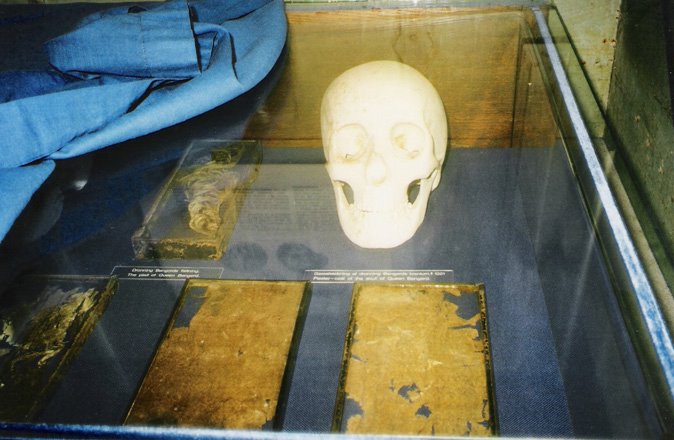
The concrete knowledge about B's life is minimal and accidental. The popes Innocens 3. and Honorius 3. confirmed her morning gift, which is unusual. The size of the morning gift, which the bridegroom gave his bride as a securing of a possible widowhood is not known. It is however seen that B gave gifts to churches and klosters, since these gifts as well as her crown after her death was excepted from the agreement of 1225 about the ransom for king Valdemar and his eldest son after their capture at Lyø two years earlier. She is the first Danish queen whose crown is mentioned. The folksong-tradition pictures B as a counterpart of her predecessor, queen Dagmar: hard, evil, greedy and selfish. Dagmar warns in one of the songs Valdemar against marrying B. "Hun er så besk en blomme." (she compares her to a bitter fruit.) But this was written in the 1500s and it is rather doubtful. According to a German-Livonian source she died in childbirth. She was buried in Skt. Bendts kirke in Ringsted. In the excavation in 1855 her skeleton was found and her shapely skull caused great attention. In the church is kept a plait from her hair.
Source: Humanistiske Studier 2/1941. Danmarks Kirker 5, Sorø Amt 1, 1936, Niels Henrik Holmqvist-Larsen.
Berengária of Portugal was a Portuguese infanta, later Queen consort of Denmark. She was the fifth daughter of Portuguese King Sancho I and Dulce Berenguer. She married Danish King Valdemar II and was the mother of the Danish kings Eric IV, Abel and Christopher I.Berengaria was the tenth of eleven children born to her parents. Her siblings included:Theresa, Queen of Castile; Sancha, Lady of Alenquer; Constance; Afonso II of Portugal; Peter I of Urgell; Ferdinand of Flanders; Blanche, Lady of Guadalajara and Matilda, Queen of Castile.
By the age of seventeen in 1212, Berengária was an orphan; her father died in 1212 and her mother had died in 1198. Her maternal grandparents were Ramon Berenguer IV,Count of Barcelone and his wife Petronila of Aragon. Her paternal grandparents were Afonso I of Portugal and Maud of Savoy. Berengaria was first cousin to the English queen Berengaria of Navarre, wife of Richard the Lion-hearted. Both of the Princess Berengarias were named after their grandfather Count Ramon Berenguer, Count of Barcelona.

Old folk ballads says that on her deathbed,Dagmar of Bohemia (Valdemar's first wife) begged the king to marry Kirsten, the daughter of Karl von Rise and not the "beautiful flower" Berengaria. In other words she predicted Berengaria's sons' fight over the throne would bring trouble to Denmark. Berengaria was introduced to King Valdemar through his sister,Ingeborg, the wife of King Philip II of France, another of her cousins. Berengaria was the youngest daughter of King Sancho I of Portugal. Within seven years of marriage, Valdemar and Berengaria had four surviving children: Erik IV of Denmark (1216-1250), King of the Danes (1241-1250); Abel of Denmark (1218-1252), King of the Danes (1250-1252); Christopher I of Denmark (1219-1259), King of the Danes (1252-1259); Sophie (1217- 2. Nov. 1247), married John I, Margrave of Brandenburg.

Valdemar's first wife, Dagmar of Bohemia, had been immensely popular, blonde and with Nordic looks. Queen Berengaria was the opposite, dark-eyed, raven-haired, yet a beauty in her own right. She was, however hard-hearted, so that she was generally hated by Danes until her early death in 1221.The Danes made up folk songs about the beautiful new queen and blamed her for the high taxes Valdemar levied, although the taxes went to his war efforts, not just to his Queen. The Danes still grieved over the kind-hearted Queen Dagmar, so that it wasn't easy for the new queen from Portugal to win the good-will of her husband's Danish subjects.Queen Berengaria, after giving birth to three future kings, died in childbirth in 1221, in her 31st year. (? her 26th year) Queen Berengaria is buried in Saint Bendt's Church in Ringsted, Denmark, on one side of Valdemar II, with Queen Dagmar buried on the other side of the King. Valdemar's two queens play a prominent role in Danish ballads and myths - Dagmar as the soft, pious and popular ideal wife and Berengaria (Bengjerd) as the beautiful and haughty woman. The study of history has found nothing which supports the work of poetry.

Berengaria was from the House of Burgundy (Casa de Borgonha), it was a cadet branch of the Capetian dynasty, descending from Robert, Duke of Burgundy, a younger son of Robert II of France. The House ruled the Duchy of Burgundy from 1032-1361. The main line of the dynasty ended with the death in 1361 of Philip I, Duke of Burgundy. His duchy was inherited by John II of France, whose mother had been a member of the House of Burgundy. Called the Afonsine Dynasty (Dinastia Afonsina), the Portuguese branch of the House of Burgundy was a cadet branch, descending from Henry, Count of Portugal. Henry was a younger son of Henry of Burgundy, the son and heir of Robert I of Burgundy who died before he could inherit the Duchy.

Portugal, Medieval Lands, Foundation for Medieval Genealogy;Valdemar II, Classic Encyclopedia; Wikipedia, Portuguese intfantas.
photo Ringsted 2002: grethe bachmann

Sunday, November 8, 2009

The First Danish Kings , 700s-800s


The written sources for mentioning Denmark in history come from abroad, from the Frankish National Annals, and later from the Germans and the Brits, often written by clericals. Local Danish sources are i.e. the runic inscriptions in stone, which makes it possible to study the daily language of the Danes at that time, another linguistical evidence is the place names. Archaeology has developed immensely and is still a valuable source. The reconstruction of the five Viking ships from Roskilde fjord, the excavations in the earliest Danish cities Ribe, Hedeby, Århus, Roskilde and Lund. And when the dendrochronology came, it meant a large step forward for archaeology. Buildings and ships could be dated, and former theories could be replaced by knowledge, i.e. that king Godfred did not establish the first section of Danevirke in the beginning of the 800s (808); the trees used for the building were cut down 70 years before 808 - namely in 737.

The English missionary Willibrord tried to spread Christianity among the Frisians, who lived outside Frankish territory, but he did not succed, and he then went on to "the tribe of the wild Danes". His kinsman, Alcuin, told about his experiences 50 years later about a man named Ongendus, who ruled there; he was more cruel than any beast and harder than a stone, and Willibrord found that he was immune to persuasion. He therefore took 30 boys with him from Denmark and hurried back to the Franks in order to teach the boys to become missionaries.

Maybe Willibrord's ship landed at Ribe, since it was the best landing place at the west coast, and maybe Ongendus' land bordered to Frisia. It must have been on the same journey Willibrord took shelter on an island, which Alcuin names Fositeland from the god Fosite, who was worshipped there. The island was situated on the border between the Frisian and the Danes, and although it has been identified as Helgoland, (which is 50 km from the coast), it is more probable that it was one of the islands in the Wattensea. The island was filled with taboos, which Willibord boldly defied; the local people were highly astounded and their king Radbod was in a rage. There was a lot of trouble about this, and Willibrord's life was very much in danger, but at last the king sent him back to the Franks with all kinds of honour to the Frankish king, Pipin. This happened before 714, the king of France was Pepin l'Heristal (Pepin of Herstal), who died in 714. (The Franks was the mightiest people in western Europe of the 700s.)

After Pepin's death in 714 Radbod conquered Utrecht, but was quickly driven back. In the end of the century, when a couple of Saxon chiefs sought shelter by the Danes, the Frankish sources throw a little light on Danish history. It is told that the Saxon chief Widukind both in 777 and in 782 took shelter by Sigfred, king of the Danes, and in 804 Charlemagne negotiated with delegates from another Danish king, Godfred about returning some refugees. Archaeology has also proved the connections abroad. Frankish, English and Frisian coins have been found in various places in the southern part of Jutland. The city Ribe's connections abroad are proved, not only by findings of imported glassware, ceramics and mill stones, but also with silver coins, some of them have been striken in Dorestad. Between Ribe and Dorestad must have been a connection in the 700s, and the ship, which brought Willibrord to Ongendus, was probably a trade ship.

The archaeological sources show a Danish connection to western Europe, but they also show that there were mighty rulers in the 700s-Jutland, one of the best evidences is Danevirke. The timber in the original bank is cut between the summers 737-738. The front of the bank turns south, and its purpose must have been to protect Jutland from invading Saxons or Slavs. According to dendrochronological examinations the north bank and the main bank were built in the same year, and if the east bank probably was built simultaneously, then this 10 km bank was built in a relatively short period. 30.000 oak trees had to be cut down for the whole stretch, transported to the place and dressed - and ab. 80.000 m3 earth and turfs. The leader must have been a person, who really understood how to get control of a large workforce.

Another evidence of the extended and effective power of the Jutland ruler was Kanhavekanalen, which crosses the narrow part of the island Samsøe. The channel is about 800 m long and 11 m broad, it was dressed with timber, which is dated to year 726. The most possible explanation for this channel is that is was meant to ease the surveillance of the ships passing the island. Kanhavekanalen made it possible for the stationed ships in Stavns fjord to catch passing ships, also west of the island. The channel was made as a benefit to Jutlands ruler. It might have had a fortification-function, but it is more probable that the meaning was to demand taxes and customs from passing ships. The Kanhavekanal was probably a royal enterprise, and together with Danevirke it shows, how great steps were taken in the beginning of the 700s in order to protect Jutland and to control the shipping along the coast.

It is a possibility that Funen was under the same ruler as Jutland, or that the ruler of Funen acknowledged the supremacy of his Jutland neighbour. Supposedly the Danish king drew back to Funen in 815 caused by the invasion of a Frankish army, but there are no other informations about this. Some Danish rulers had the supreme power in large parts of the country , maybe in the whole country. In the beginning of the 800s king Godfred ruled not only in Jutland, but also in the southern Norway and probably also in Skåne. He could easily control the traffic between the Baltics and western Europe, which meant an important influence in all of Scandinavia. Such an early Danish supremacy might explain why the old Norse language in the Middle Ages was mentioned as "the Danish tongue" - even at Iceland.

The name Danmark is used for the first time in Ottar's and Wulfstan's accounts of their journeys written in the 800s. Short reports from their journeys were printed in an English translation of a World's History, which the Spanish cleric Orosius wrote in the beginning of the 400s. The translation was made for king Alfred and is kept in a manuscript from the time shortly after his death in 899. Both Ottar and Wulfstan said that the islands east of Jutland belonged to Denmark, and Ottar placed Halland and Bohuslen as part of Denmark. The name "mark" might mean border or border area, the most reasonable explanation is that the Danish "mark" was the islands and western Sweden, namely Skåne, Halland and maybe Bohuslen, while the Dane's own country was Jutland. This fits with Alcuins description as Ongendus being king of the Danes and Ottar's words that Hedeby in Jutland was Danish. The old Byzantic historian Procopius from the 500s tells in his desription of the Herulis' migrating that they passed the Dani-people, before they went across the sea to Thule (=the Scandinavian peninsula), where they settled next to the Gauti (the Goths). The name Danmark was probably first used about the Danish kingdom in the 900s, when Harald Blåtand wrote his famous words on the Jelling stone that he "vandt sig al Danmark" ( he won all of Denmark). But the earliest history about Denmark is dark and with few informations.

The Danish kingdom was an island kingdom, united by water, and the communication traffic was dependent on ships. The Franks experienced this when they in 815 (Frankish king: Louis the Pious) sent and army to Jutland to fight the Danes, since the Danes had withdrewn to an island, possibly Funen. The Frankish army was met with fjorde, widespread moors and marsh areas, even small water streams were difficult to pass caused by swampy banks.The famous army road (Hærvejen) might have been difficult to pass to a foreign army, who was not familiar with the land. The Franks had no ships, they had to return to their homeland and king Louis without having achieved anything, while the Danes and their ships patiently awaited their departure on Funen.

Villages and farms formed larger unities, bygder, (rural area),which often had natural borders, like coast and water streams. Some of the names are still seen in the syssel- and herredsnames, like Vendsyssel, which original was named Wændæl or Wændlæ; it contains the name of people who lived by Limfjorden. (DK: Vendelboer) The inhabitants of the bygd probably ruled their own affairs and met at the Thing to decide feuds and cases of inheritance. Some sources mention men from the bygd as magnates and rulers/chiefs. Rune inscriptions were only for the chiefs and some inscriptions refer to the man's supremacy over a local area, using the word: gode. At Iceland the word godi was used for chiefs. The support of a strong chief meant safety, and in return the chief could expect services or some form of economic payment. Rune inscriptions and scald-poems tell about aristocratic ideals and in "Ansgars Levned" (life of Ansgar) there is a little information about religious habits. The title gode shows the leader's religious role, it comes from a word meaning priest, but although the chief was in charge of religious rituals, he was not a priest, and although a chief's house was named hov, an old word for temple, it was not a temple.

Many Danes were probably healthier, better nourished and materially better off than their descendants in the 1800s. Examinations of skeletons from the Danish Viking period show that men's height varied from 163 to above 184 cm , an average of 172,6, which is 4 cm more than measured at the sessions in Schleswig-Holstein 1876-80. The farms found in the village Vorbasse were large and similar to later Danish farms. People were dependent on their own production, but they were also able to import wares from other parts of Scandinavia and from Germany . Although people usually stayed in their local area, the societies were not isolated. There was contact and influence from abroad via trade, diplomacy, Christian mission and Viking expeditions. New ways of producing cloth and new styles in decoration, a new religion and a developing language. The foreign influence came first to the rulers, the chiefs and magnates, and these people and especially the kings deliver most information from the earliest Danish historical period.

About year 800 the Franks had after 20 years won over the Saxons, and the Danes and the Franks were now neighbours. In the first half of the 800s were many contacts between the Frankish and Danish court. Frankish sources from 782 and 873 mention several Danish kings and give some informations about the Danish kingdom. Two rival families claimed the throne. One line worked together with the Franks, the other was hostile to the Franks in the beginning. From 804 to 864 all known kings and pretenders belonged to those two families. Maybe they represented dynasties, who earlier had ruled over lesser kingdoms, which were now a part of the Danish kingdom, but it is more likely that they were branches or parts of the same dynasty. Both families used the names Hemming and Godfred. The brothers Sigfred and Halvdan ,who are mentioned as kings in 873, must have been from the same family as earlier kings with the same name. One of king Godfred's kinsmen was named Angandeo, which indicates that they were all kinsmen of the king Ongendus, whom Willibrord visited in the beginning of the 700s.

If the rival families were from the same dynasti, then the dividing probably happened in the late 700s. In 850 king Horik from one of the families had to share the kingdom with two nephews, and in 854 almost all family members were killed in a fight where Horik was being challenged by a third nephew Gudurm, who had spent some years abroad as a viking chief.

King Sigfred is mentioned in 777, 782 and 798. In 777 the Saxon leader Widukind sought shelter by Sigfred, and in 782 he came once more, where Sigfred was king. King Sigfred's relations with the Franks is not exactly known, but in 782 it must have been clear to him that the Frankish power was a threat to Denmark. Delegates from Sigfred participated in a meeting, which Charlemagne held in Saxony near Paderborn shortly before a rebellion broke out. It is not known why the delegates came, but it had nothing to do with Frankish supremacy over Denmark, and likewise there was nothing about Danish submission in 798, when a delegate from Charlemagne came to king Sigfred, and this delegate is only mentioned because he was killed on his way home.

Neither Sigfred nor his successor Godfred gave in to the Franks, but the Danes who came to the Frankish court, either as delegates or refugees, must have been impressed with the pomp and circumstance there. Some Danes wanted to keep independence above all, while others were ready to have something to do with the mighty neighbours. In 807 the aristocratic Dane Halvdan offered Charlemagne his service. This happened while Godfred was king, and since he was hostile to the Franks, Halvdan might have been one of the refugees. He might be the Halptan who was the leader of the Danish delegation to the Franks in 782.


King Godfred
King Godfred is mentioned the first time in 804; he died in 810.

In 802-804 there were fights south of the Danish border between the Franks and the Saxons, where the Franks were the winner. In 804 Charlemagne had a base in Hollenstedt at the river Elbe. This was too close for Godfred's nerves. The same year he gathered a navy and a cavalry in Sliesthorp at the border of his kingdom. According to the Frankish chronicle-writer Godfred promised to take part in a meeting with the emperor, but since his men warned him not to, he sent substituts to the meeting. After the negotiations Charlemagne sent a delegation to Godfred to discuss the return of refugees, probably leaders of the Saxon rebels.

Four years later (808) Godfred attacked the Abodrits and was supported by other Slav-tribes. The Franks were afraid if he would invade Saxony and they sent an army to defend the river Elbe against "den gale konge" ( this crazy king). But Godfred only wanted to fight the Abodrits, and the Danes lost many men, one of them was Godfred's nephew Reginold. The leader of the Abodrits Thrasco was driven out, another leader was hanged and several important cities were captured. Godfred came home with the Reric-merchants whom he had forced to follow him from their own town, and soon after he returned to Denmark he started to reinforce Danevirke. At the same time the Franks built two castles by the river Elbe. It seems that there was mutual respect from both sides.

But Godfred still tried to spread his influence beyond the borders of his kingdom. He forced in 809 the Abrodit chief Thrasco to give his son as hostice, and later the same year he killed the chief. A Danish navy attacked in 810 Frisia and demanded tax from the inhabitants. The Franks were alarmed and in spring 809 they built a fortification at Itzehoe ab. ten km north of river Elbe. After the Danish attack on Frisia in 810 Charlemagne himself took command over his army. The Franks were ready for a Danish attack, but they had also heard rumours that Godfred boasted about conquering Aachen, the headquarters of the emperor. The Franks were nervous, and when Charlemagne was thrown off his horse and seriously wounded they saw it as an omen of his death.

Godfred had supremacy over a larger area than the Danish land, he had Vestfold west of Oslo fjord , he took taxes from both the Frisians and the Abrodits. His supremacy was acknowledged by those, who had the power over the various sections of the extensive territory, local rulers, who are often mentioned in rune inscriptions. He had to maintain his power by display of force or threats, and after his death in 810 the rebellion lurked under the surface. In 813 the princes and the people of Vestfold denied to subject to the new kings, who had to fight for their authority. The contemporary Anglo Saxon and Frankish rulers received a tax each year from their under-kings, it was likely the same in Scandinavia. According to a Norwegian king-legend from the 1100s by Ågrip the earls of Lade paid 20 falcons each year to the Danish king. So an overlord gave gifts to his under-kings and chiefs, and they all shared the profits from lucky war expeditions. The tributes, which the Abrodits paid king Godfred, also made his followers rich.

Godfred was murdered late in 810, and the murder might have been arranged by the Franks. His successor king Hemming began peace negotiations at once, and in 811 they were confirmed by twelve delegates from each side, two of the Danish delegates were Hemming's brothers, and all 24 delegates were of the highest rank. The conditions of the tractate is not kown , it was suggested that the Danes negotiated from a weak position or that they acknowledged a Frankish supremacy, but the Franks knew that the Danes would not go for such an agreement tooth and nail. It would be very difficult to conquer the Danes in their own land , their ships could withdrew from the Frankish army and still stay in their own country. They did so in 815, and after this event the Franks did not attempt another intervention. They also knew that if they conquered Jutland they would never be safe there, since the Danes could operate from the islands or other sections of their land.

Godfred was not only a mighty king and warrior, he also knew that it was important for at country to have good trading connections abroad. According to the Frankish National Annals Godfred came home from the lucky war against the Abrodits in 808 and founded Hedeby. But before he went home he destroyed a trading place named Reric, which had brought great advantages to his kingdoms via taxes and customs. He took with him the Reric-merchants on his ships and sailed with his army to the harbour called Sliesthorp where Godfred wanted to build as market place. Since it was unprotected he let build a new embankment, named Kovirke, where parts of it still exist. After finishing the bank the houses for the merchants and their families were built. The dated timber show that the work first started after Godfred's death. The raison d'être of Hedeby was the trade. It also became an important arts and craf-center, but only because the craftsmen could sell their work to people who came to the market to buy or sell the large election of imported wares. Tradesmen from the North Sea, the Baltic and Saxonia met at Hedeby, the city had the ideal position as a centre of North European trade.

Hedeby had many inhabitants, but the excavations of houses have not showed any buildings, which were suitable for a magnate or a royal official. Maybe they did not live in the crowded trading place but on the other side of the coast. No matter if the king's men lived in the town or not, then there is no doubt that Hedeby was under royal control. King Godfred was not only the founder of the city, but his allowance was needed if they had to build a church or hang up a church bell. He had forced the Reric-merchants to move to Denmark. The chronicle-writer calls them traders (negotiatores), who had to travel back and forth in order to do their business - and maybe hostages were taken from their families in order to make them return to Hedeby.
King Godfred's motive to create hedeby was to take customs from the merchants On the medieval markets the merchants had to pay a tax before they could do business.

That time Hedeby was called Slesvig.
An English chronicle-writer says that it was known in the Saxon language as Slesuuic, but known by the Danes as Heithaby. The Danish name meant "the city on the heath" while the other name meant "the city or the market place by Slien". Clericals from the Saxon bishopric called it Slesvig, and in the 1000s and maybe even earlier the cathedral stood on its present place north of the fjord, which was named Slesvig, although it during centuries kept the alternative name Hedeby. The Frankish annals name another name Sliesthorp. Godfred sailed to Sliesthorp with the Reric-merchants in 808, and four years before Godfred gathered a navy and an army at the same place. The Franks feared that he would invade them and their Slavic allied. This name has disappeared, but the place Sliesthorp was at Slien, probably on the north coast at the first section of Danevirke.

The agreement of 811 was a private one between Hemming and Charlemagne via their representatives, but after Hemming's death late 811 a new agreement had to be arranged with the king's successors, the brothers Harald and Reginfred. It was confirmed in spring 813 by 16 representatives from each side. Later in 813 Harald and his brother were driven out of their kingdom by Godfred's sons who returned from exile by the Swedes together with other magnates. After a failed attack to regain the power Harald went to the Franks for help, namely to their new emperor Ludwig the Pious, who was the only living son after Charlemagne, who died in January 814. Harald paid tribute to Ludwig, and he was the first and only Danish king (although exiled) who acknowledged Frankish supremacy.

The year after, in spring 815, Ludwig sent an army of Saxons and Abrodits to occupy Jutland, but as mentioned before, they did not succeed in meeting Godfred's sons, who withdrew with their fleet to and island, probably Funen. Ludwig's troups had to return without results. Harald could not reign in Denmark without the help and presence of the Franks and had to stay in Saxonia for a while, but from his base he troubled Godfred's sons as much as possible. They appealed to the emperor in order to get peace, but the Franks kept on helping Harald, they were suspicious of Godfred's sons, because they supported a group of Abrodits, who were in opposition to the Franks. In 817 a Danish fleet together wih an army of both Slavs and Danes made a failed attack on the Itzehoe-fortification. Some Abrodits were loyal to emperor Ludwig, and with their help Ludwig saw to that Harald was restored in 819 as king in Denmark.

The annals say in 621 that Harald joined a partnership with Godfred's sons, but the good relationship did not last long, and in 823 Harald appealed personally to the emperor for help. The Franks were a little uncertain of his interpretations about the case, and they sent two Frankish counts to Denmark ahead of Harald, they examined the case and presented it to the emperor. In 825 the emperor and Godfred's sons agreed about the peace conditions. Harald did not get the military support he had counted on. In 826 Harald and his wife and son were baptized in Mainz in an impressive ceremonial with emperor Ludwig as godfather. Now as christian king Harald repeated the tribute he had given the emperor 12 years before. He came home loaded with gifts, but he let his son and his nephew Rorik stay in the imperial palce, probably as privileged hostages.

In 827 Harald was driven out by Godfreds sons, but he did not go to Rüstringen, where the Franks had given him a place of refuge after his stay in Mainz. He stayed close to the Danish border where he caused lots of trouble; he also broke agreements, which had been made between the Franks and the Danes. The Franks wanted to stay on friendly terms with the Danish kings, Godfred's sons, and Harald had to look in vain for any support. But neither Godfred's sons or their successors ever acknowledged Frankish supremacy. Harald was the only 800s-king who did and the only one who got baptized. The Frankish National Annals end in 829, and although there are various sequels, the situation in Denmark was of little interest. Harald is not mentioned until 833 in a feud between emperor Ludwig and his sons.The eldest son Lothar wanted to undermine his father's power, and he urged Harald to attack Dorestad.

It is not known how the order of succession was. After Godfred's death his nephew Hemming became king. He was the eldest living relative. When Hemming died, his eldest brother claimed the throne, but he had a rival, Anulo, who was a nephew of king Harald. Little is known about him, he was possibly before Godfred, who is mentioned the first time in 804, but it is also possible that he was contemporary with Godfred. The power as king was divided at several occassions, usually among brothers. In 812 two brothers, Harald and Reginfred, became kings, but the following year they were driven out by Godfred's sons, who for some years ruled together. The Frankish sources only mention one of Godfred's sons, namely Horik (I), who was sole ruler in 848 and possibly also before. He is mentioned the first time in 827, but he was not a sole ruler at that time, the following years Godfred's sons are mentioned as kings of the Danes.

An accession of a new king might have required an election. A consent from other members of the royal famlily, from the magnates and the chiefs was necessary. Only in 812 the case was settled with a fight between Sigfred and Anulo, who couldn't hit it off, and both pretenders were killed. Anulo's party was considered winner and his brethren were elected kings (Harald and Reginfred). A new king was probably inaugurated in ceremonious rituals. Centuries later the king was inaugurated in Viborg, in line with the Lejre-Chronicle from the 1100s, where it is told that the legendary founder of the kingdom, king Dan, was put upon a large stone in Viborg, when he was proclaimed king. This is not unlikely; similar ceremonies are known from other European countries.

In the 800s the Danish kings were often challenged by rivals, who came home after a stay abroad. Those who are mentioned in the Frankish annals are all members of the royal families. As mentioned before came Godfred's sons home from exile in Sweden and drove away the brothers Reginfred and Harald. Reginfred was killed the following year, but Harald spent many years in exile by the Franks. In 855 his son Godfred and his nephew Rorik tried in vain to win the throne after Horik I's death. Instead a young relative of Horik with the same name was elected king (Horik II). He still lived in 864 when pope Nicolai I sent him a letter. It is not known when his rule ended, or if he died a king. In 873 two brothers Halvdan and Sigfred were king of the Danes. They each sent delegates to the German king Ludwig in order to secure the peace at the Ejder-border. This shows clearly that they shared a united kingdom.

The next century is dark and the Danish kings are not wellknown. In the last quarter of the 800s English, Frankish and Irish sources mention several viking chiefs as kings of the Danes, it was presumed that these viking chiefs were rulers in Denmark at the same time ravaging the western countries like Sven Tveskæg later did. Halvdan on the British Isles in 871 and 877, Sigfred at Elsloo near Maastricht in 882, were identified as the Danish kings who are mentioned in 873. But this is hardly true. A king in the early Viking period could not allow himself to stay away from his country for a long expedition. He had to maintain his power and position as king. Halvdan and Sigfred who were the leaders of several attacks abroad, were probably expelled from Denmark. Several members of the dynasty had these names. Other royal leaders of Viking armies in England, like king Bagsec in 871 and the kings Godrum, Oscetel and Anwend in 875, had evidently no connections to Denmark, although Godrum had the same name as Horik's nephew who was killed in 854. Some of these kings might have been elected by their armies like Canute the Great was in 1014.

Finish.

Source: Gyldendal & Politikens Danmarkshistorie, Bd. 3 , Peter Sawyer, "Da Danmark blev Danmark", 1988.

Friday, October 30, 2009

Valdemar II Sejr and Dagmar, Berengaria and Helene


Dagmar, –1212, Valdemar Sejr's first queen, was a daughter of king Premysl Ottokar I of Bohemia and Adela of Meissen. Ottokar had been living in ab. 20 years of marriage to Adela, when he under the pretext of too close kinship applied for divorce (ab. 1198) and married Constantia of Hungary. Adela went with her children, 1 son and 3 daughters to her homeland and applied in vain during many years via help from the Pope to regain her rights; she died in a kloster, which she had established in Meissen 1211. One of the daughters became an abbess and was after her death considered a saint, another got married in Bavaria. The third daughter, Dagmar, was brought to Denmark as king Valdemar's bride in 1205. Her mother's hard fate had probably early matured Dagmar and developed the best sides of her character; as queen of Denmark she won the Danish people's love and affection, and she was described in contemporary poetry as the paragon of a faithful wife and humble Christian and as the princess, who always wanted to ease the life of the suffering. The Danes gave her a name which bears witness of this. Her church name was Margareta/Margrethe , the other was a Slavic name Dragomir/Drahomir (meaning peace-loving) was by the Danes changed into Dagmar - like Vladimir became Valdemar - among people her name was interpreted as Dagens Mø (Dag-Maar).(a beautiful lady).

Historical sources know little about her, but they know like the folksongs that she influenced king Valdemar to free his relative, bishop Valdemar, who had been Valdemar's prisoner for 13 years. In 1209 she gave birth to the son Valdemar. After only 7 years of marriage she died 24. May 1212. A beautiful folksong was written and sung by people about her illness and Valdemar's long ride to come to her deathbed. The folksong says that when Valdemar kneeled at her bier, she woke up and told him about her last pious wishes and about her gnawing self-reproach , because she had sinned "on Sundays I have laced up my sleeves". Dagmar's grave is in Ringsted kirke (St. Bendts) beside Valdemar's; when it was opened in 1855, it was empty.

Schiern, Hist. Studier II, 208 ff. Grundtvig, Danmarks Folkeviser III.
After Johannes C. H. R. Steenstrup's Danish text: grethe bachmann
Dansk Biografisk Lexicon
Carl Fr. Bricka
Project Runeberg

Berengaria, –1221, Valdemar Sejr's second queen, was the youngest daughter of king Sancho I of Portugal and queen Aldonca. When her mother died in 1198 after 24 years of marriage and after having given birth to 11 children, B. was probably born after 1192. After the mother's death B. was brought up by her eldest sister who had been married to king Alfonso of Leon. The Portuguese chronicles assume that she died unmarried , but maybe she during the sisters' feud with their eldest brother king Alfonso I of Portugal, went to her younger brother, Ferdinand, who via his marriage to (Jeanne de Flandre) had become a count of Flandern, and from there she could easily be known in Denmark.

In 1214 she was married to king Valdemar. She became the mother of 3 kings, but died already 27. March 1221, leaving a reputation about a great beauty, but also about arrogance and strictness, especially against the peasantry. This rumour was taken up by the folk poetry and used freely, since the folk songs changed her name into "Bengjærd" which was not flattering. When her grave was opened in 1855, her bone structure confirmed the rumour about her beauty; but some trouble around the grave after her death also indicated the hatred against her. None of her sons named their daughters after her.

Duarte Nunez, Primeira parte das Chronicas dos reis de Portugal, reformadas, Bl. 64 v.
Suhm, Hist. af Danmark IX.
Worsaae, Kongegravene i Ringsted Kirke.
From J. Kinch's Danish text: grethe bachmann.
Dansk Biografisk Lexicon
Carl Fr. Bricka
Project Runeberg


Article in Thyra-blog from Dec. 2005:
Queen Berengaria of Denmark

Skt. Bendts Church, Ringsted


When queen Berengaria's grave was opened in 1885, they found her thick plait of hair, her finely formed skull and finely built body bones. A portrait drawing was made to show how she might have looked. Berengaria was a daughter of king Sancho I of Portugal and queen Aldonca and a descendant of Robert Capet. She was married on May 3rd 1214 to king Valdemar II Sejr of Denmark. She became the mother of three kings, but she died already on March 27th 1221 and was buried in Sankt Bendts Church in Ringsted, the burial place for the early Danish kings and queens.

Her three sons and a daughter with Valdemar:
Erik IV Plovpenning, born 1216 , king from 1241-1250; he was murdered by his brother Albert at Slien August 9th 1250. Erik was married to Jutta of Saxony.
Albert, born ab. 1218, king from 1250-1252, was killed in a battle against the Frisians at the peninsula Eiderstedt June 29th 1252. Married to Mechtilde of Holstein.
Christopher I, born 1219, king 1252-1259, died in Ribe May 29th May 1259, possibly poisoned by altar wine. Married to Margrethe Sambiria of Pommern.
Sophie, who was married to Johan 1. of Brandenburg in 1236. She died November 2nd 1247.

Eleonora of Portugal, Berengaria's niece, was a daughter of Berengaria's brother, king Alfonso II el Pancudo and Urraca of Castile, she was married in 1231 to Valdemar the Young, Valdemar's son with his first queen, Dagmar of Bohemia. Eleonora was born in 1211 and died in childbirth August 28th 1231, her child died the same year. Valdemar the Young was killed by an accidental shot at Refsnæs November 28th 1231. Buried in Ringsted with Eleonora.

-------------------------------------------------------------------------------------------------
Helene Guttormsdatter, 1172-1211, the wife of Esbern Snare, was a daughter of the Swedish earl Guttorm, who once fetched king Carl Sverkersons bride in Denmark and on the same occassion was godfather of Valdemar I den Stores son Knud (1163). Helene was probably named after the Holy Helene of Skøfde, a celebrated saint , who was canonized in 1164 and wellknown in the folklore of northern Sjælland. When Esbern Snare lost his second wife Ingeborg he - although not quite young anymore - married the young beautiful Helene. In this marriage was born the daughter Ingeborg af Kalundborg and maybe more children. Soon after Esberns death in 1204 Helene became Valdemar II Sejr's frille (mistress) and had the son Knud. But in 1205 Valdemar married Dagmar of Bohemia , and his relationship to Helene supposedly stopped - it seems that Helene left Denmark. She died in Roskilde ab. 1211, but she was not buried in Sorø like Esberns other wives , and from diplomas from the 14th century it appears that she established 'Vor Frue Kapel' at Linköbing Cathedral, where she probably chose her burial place. (NB: She died in 1211 39 years old, and was buried in Vreta Kloster). Her gifts to the church were later increased by her son's son Svantopolk Knudsen and his family.

Valdemar II Sejr honoured his and Helene's son Knud by making him a hertug, ( Knud of Blekinge) , and he gave him his own property in Sweden. Helene left him a considerable inheritage there too. Knud was married to Hedvig, a daughter of duke Svantepolk in Poland. They had the before mentioned son Svantopolk, who was married to Benedicta, a granddaughter of king Sverker 2. of Sweden and Ingegerd, and two daughters, Elisabeth, married to duke Erik of Halland, and Cæcilie, married to Philip (Folkunge).

Helene Guttormsdatter's ancestors
:
1. Ingrid Guttormsdatter af Rein * ab.1160 ~ Guttorm Austmanson, * ab 1156
2. Guttorm Åsulvson, + after 1183 ~ Eldrid Jonsdatter of Blindheim
3. Åsulv Skuleson på Rein ~ Tora Skoftesdatter of Giske,
4. Skule Kongsfostre Tostigson, Earl of Rein, * ab. 1053 ~ Gudrun Nevsteinsdatter
5. Tostig Earl Godwineson, + 25 sept. 1066 ~ Judith of Flandern, * 1033 + 4 march 1094
6. Godwine Thegn Earl of Wessex * ab.992 + 15 april 1053 ~ Gytha Thorgilsdatter * ab.997
7. Wulfnoth Child Thegn of Sussex ab. 960-1015 ~ NN

Wulfnoth was the grandfather of king Harold II of England, Gytha Thorgilsdatter was a great granddaughter of Harald Bluetooth, Judith of Flandern descended from the dukes of Normandy and Rollo, and Skule's wife Gudrun Nevsteinsdatter descended from Harald Hårfager in Norway, so Helene's ancestors were a part of the big genealogical wickerwork with connections to the old Danish and Norwegian Royalty and to Anglo-Saxon England and the Normans in France.


Thursday, October 29, 2009

Valdemar II Sejr, 1170-1241


Valdemar II, 1170-1241, King, son of Valdemar I and queen Sophie, was born around Skt. Hans dag (24 June) 1170; already when young his bold and lively personality caused great expectations, and he was the obvious candidate for the position as hertug in Sønderjylland which his father and grandfather had been. This position was temporarily entrusted to his cousin bishop Valdemar Knudsen, but when V. was 18 years old, it was given to him. The relation between the two kinsmen was soon tense, and V. took various castles and estates from the bishop, probably with good reason, since he discovered that his cousin joined the enemies of the country; at any rate the bishop was not backed up when a papal delegate after V.'s request investigated the case. The bishop took flight to Sweden shortly after, and when he recklessly attacked Denmark, V. took him prisoner.

Grev Adolf III of Holstein was a very restless neighbour, and both on this occasion and later he showed a clear enmity towards Denmark, but he awoke some aversion in his own country, and several of the displeased went to see V. in Schleswig. To keep him in check V. fell into Holstein and conquered the open land and Hamburg and Lübeck, but he wasn't able to win Lauenborg. In a bold attack Adolf took back Hamburg , but unexpectedly stood V. on Christmas Eve upon the banks, and Adolf had to buy himself free by handing over Lauenborg. The defenders of Lauenborg would not give in to V. though, and thus Adolf had to go to prison, which was greeted with hilarity in Denmark. When king Knud died without sons 12 Nov. 1202, V. was unanimously elected king, and archbishop Anders Sunesen crowned him on Christmas Day (25 Dec) in Lund's domkirke. The next summer V. went with a large army to Elben; in Lübeck he was greeted as the lord of Nord-Albingien, and soon after gave Lauenborg up, if grev Adolf was released. V. placed his sister's son, the young grev Albert of Orlamünde as lord of Nordalbingien, and he ruled the country with just and skill. (Nordalbingien = a district in Sachsen)

In June 1204 V. made an expedition to Norway to support the Bagler's pretender Erling (Stenvæg); the swords were however not drawn, and the expedition had no importance, although Erling greeted V. as his overlord; later on V. did not interfere in the Norwegian affairs. But there were still trouble on the southern border of the kingdom, not least after V. on many's intercession had released bishop Valdemar from prison, and he then against his promise had let himself be elected archbishop of Bremen. Furthermore showed the two brothers, grev Gunzelin and Henrik of Schwerin a hostile attitude, why V. let their grevskab (county) occupy and forced them to pay tribute to him as their feudal overlord. During the feud between German's two rulers Otto IV and Philip, V. sided for Otto and supported him with money and auxiliaries, but after Philip was murdered (1208) ,Otto felt safe and was ready to turn his weapons against Denmark. Otto soon got a rival in Frederik II, and when Frederik achieved still more power in Germany, V. joined him. Frederik's interest in the north German countries was so little that he made over all countries north of Elben and its tributary Elde to V. (Dec. 1214) ,which was confirmed by pope Innocent and Honorius soon after.

But V. wanted to extend his power to more distant countries, he wanted to free the Baltic from the pirates and spread Christianity to the heathen people at its coasts. After an expedition where he conquered Øsel, but could not yet keep it occupied (1206), he went on a crusade to Preussen and Samland, and the hertug of Pomerellen had to pay tribute to him (1210). Most important was the great expedition to Estland in 1219. With a fleet of 1500 ships he landed at Lyndanise. The Estonian chiefs seemed willing to subject to him and to be baptized, but one evening they attacked the Christian army, which had to do a severe fight with the Estonians, whom they beat completely. According to tradition the cross banner (Dannebrog) fell down from the sky in connection to this battle, why the army went fighting again and won a victory. Using the castle Reval as a point of support the Danish power spread in the whole country, V. lead two expeditions there himself, (1220, 1222), but the occupation was still not secure, and it was lost, when the years of disaster arrived.

Before telling about this, V.'s personal relations must be mentioned. He married late (when he was 35) . He had a relation to Helene, who was a daughter of the Swedish jarl Guttorm, she was a widow after Esbern Snare. Helene and V. had the son Knud, and with an unknown woman he had the son Niels, who was married to Oda, a daughter of grev Gunzelin of Schwerin, they died early and left a son, Niels. Finally V. married the Bohemian princess Dagmar in 1205, whose beauty and goodness won all hearts, she bore the son Valdemar in 1209, but died already 24. May 1212. Two years later V. married the beautiful princess Berengaria of Portugal, she bore the sons Erik, Abel, Christoffer and the daughter Sophie; the next birth cost her life 27 March 1221.

In the night of 6.-7. May 1223 the reversal happened in V.'s and his country's history. The king was together with his son Valdemar hunting at Lyø, when grev Henrik of Schwerin broke into their tents and after a short fight brought the kings as prisoners on his ships. Grev Henrik wanted to revenge that V., probably wrongfully and on behalf of his grandson during Henrik's stay in the Holy land, had taken half of the castle Schwerin into possession, although it was a pawn for the dowry of Henrik's brother's daughter Oda. Henrik brought his prisoners to his castle Lenzen, and then to a castle Dannenberg on the left bank of Elben. This deed awoke horror and immediate perplexity in Denmark. Grev Albert took the position as rigshøvedsmand (regent) , and the Danes turned to the pope for help. After emperor Frederik's efforts to have the king handed over had failed, various attempts were made during a year in order to reach an agreement with grev Henrik, but the conditions were too hard, and the Danes were said to have broken the negotiations themselves. The allied German princes, who had freed themselves for obedience to V., now fell into Holstein; Albert lost a battle at Mølln (Jan. 1225), he was taken prisoner and put into prison in Schwerin, where the kings had been brought. Lübeck was lost, and Hamburg gave up to grev Adolf. There was now no other way than make an agreement on the hardest conditions. The king had to pay 45.000 mark silver and many other payments, he had to give up all countries south of Ejder and the Wendic countries, except Rügen and what belonged to this island. V. and the other prisoners had to be released from prison gradually with the payment of the ransom.

At Christmas time 1226 V. returned to Denmark, and still for some months after the release he kept a low profile, but then his revengefullness awoke, and he was by pope Honorius loosed from the oath he had sworn grev Henrik. He fell into Holstein, but the battle at Bornhøved 22 July 1227 brought him a crucial defeat, and he lost one eye in the fight. From now on V.'s policy completely changed character. In some negotations with grev Henrik's widow he achieved in Schleswig in 1230 an agreement in which the ransom was reduced considerably, and the young princes, who had gone to prison instead of their father and brother, could came home to Denmark. V. made some friendly connections to the north German princes; his son Abel married a daughter of grev Adolf of Holstein and his other children were married to Germans. But the ransom had brought a strong economic pressure upon the country, futhermore occurred a cattle plague in 1230 and a famine, which killed many people; and V. lost his eldest son (Valdemar den Unge) the year after; he had to live through dark hours, but he matured by the disaster, and he showed during the last decade of his rule an important activity in the government of the inner conditions of the country.

V. was during all his rule a faithfull friend and protector of the church; in archbishop Anders Sunesen he had an excellent helper in his crusade-activities, in bishop Gunner in Viborg he had a loyal advisor. He showed his warm interest for the church-life in numerous gifts to churches and klosters. Most important during king V.'s work was his close connection to the popes and their help in his activities. Innocent III had assisted him in the feud against bishop Valdemar and the German princes, Honorius III had been working for his release from prison, Gregor IX had in many ways eased his economic stress in his last ruling period. All these popes showed furthermore in several free pardons, how much they appreciated V. and his work for the Danish church. Pope Gregor also saw to that V. got Estonia back. V. had not given up to regain his control there, the brothers of the sword were pressed by their heathen neighbours, and via clever negotations in Rome V. made the pope order the brothers to give Estonia back to Denmark. In an agreement in Stensby at Vordingborg in 1238 the German Knights' Order (in which the brothers of the sword now were a part) handed over the lands Reval, Harrien and Wirland to V.

In all fields in V.'s government his organizing hand was felt. Statistic and economic informations about the incomes of the country, the estates of the Crown and the king's family estate were collected, all about which is written in "Kong Valdemars Jordebog". V. published several statutories , but it is especially his great credit that he wrote "Jyske Lov" with the advice of the best experts; it was given in Vordingborg in March 1241 and has had an extremely importance to the judicial life of the Danish people. During the next hundred years is often referred to the judicial state of things on king V.'s time as the normal and also golden age. When the first 20 years of his rule gave him the name "Sejr", which he has been called since the 16th century, then he might as well rightfully be called legislator, which he was called already in the 14th century. What is less approved in his rule is that he gave many parts of the country to his sons, (Abel got Sønderjylland, Niels Nørrehalland etc. ) or to kinsmen. Some transfers were necessary replacements for the loss which the disastrous years had brought, others V. meant were useful for the defence of the country, but the following period revealed the danger of such a parcelling out.

King V. died Skærtorsdag (Maundy Thursday) 28. March 1241 in Vordingborg and was buried in Ringsted kirke. – There are no informations about V.'s looks and almost no informations about his appearance. But he was well liked by everyone, it is never mentioned that a Danish man was his enemy, and it is never told that he bore a grudge to anyone. There were no rebellions or unrests during his rule, and even during the years, when he was imprisoned, there was no break in the king's peace. It is known about his versatile interests, that Icelandic scalds sought him and was met with hospitality; Olaf Hvítaskáld mentions the king's great knowledge, and how he tried to change the runic alphabet into Latin letters. The Icelandic Sagas called V. the most excellent king in the Nordic countries. Contemporary sources from Denmark speak about him in gratitude and admiration, tradition never writes about any evil deed; it has only praised him as a victor and grieved when he was unfortunate. When he died - the annals had to say not long after: "faldt kronen af de danskes hoved". ("the crown fell from the head of the Danes.")

Johannes C. H. R. Steenstrup.
Dansk Biografisk Lexicon
Carl Fr. Bricka
Project Runeberg

Wednesday, October 28, 2009

Valdemar I's Queen, Sophie & his mistress Tove


Sophie, o.1140-98, queen,( note: a daughter of prince Volodar and Richiza Swentoslawa), was a halfsister of king Knud, Magnus' son, since her mother Richiza after the fall of Magnus had married a Russian prince Volodar, whom she had left in order to marry king Sverker in Sweden. After Valdemar, Knud Lavard's son, had began turning away from the union with Svend and to make up with Knud, a marriage was arranged between Valdemar and Sophie; she was adolescent, but showed signs of being really beautiful, and since she had no estate in Denmark, Knud promised to give her 1/8 of his paternal inheritance as a dowry. S. was brought to a woman Bodil, who had to take care of her upbringing, but after Knud's murder in Roskilde Valdemar married his bride in Viborg (1157); after the victory at Grathehede some brakteaters (coins) were made with his and S.'s portraits. Valdemar and Sophie had the sons Knud and Valdemar, and the daughters Sophie, Richiza, Ingeborg and Helene, and two daughters, who became nuns. Svend Ågesen (Aggesen) speaks about Sophie's beauty in great admiration, she seems to have been a self-assured, ambitious personality. After Valdemar's death 12. May 1182 landgrev Ludvig of Thüringen, who had repudiated his wife, proposed to the Danish queen; he was one of Germany's mightiest princes, outspoken and intense. King Knud accompanied his mother with a great entourage and equipped with costy belongings , to Ejder where the landgreve received her. But Ludvig quickly changed his mind and sent S. ashamed back to Denmark,; he went on a crusade and died on the journey home (1190). S. died 5. May 1198 and was buried in Ringsted kirke at king Valdemar's side.

Johannes C. H. R. Steenstrup.

Children:
Valdemar II, 1170-1241, King, Son af Valdemar I og Sophie, born around St. Hans 1170 (24 June) See special article about Valdemar II Sejr.

Knud (Valdemarsen), 1163-1202, King, son of Valdemar i and Sophie, born in the beginning of 1163 , baptized by Absalon, crowned 25. June 1170 in Ringsted. When children engagement to Richiza , daughter of Henrik Løwe; richiza died 1167; engagement to her elder sister, the widow Gertrud, Marriage 1177 when Knud was 14 years. He was king from 12 May 1182.No children.
esteg K. Tronen.

Sophie,
Grevinde of Orlamünde, –1181–, eldest daughter of king Valdemar and queen Sophie; married to grev Siegfried of Orlamünde. 8 children, the eldest Albert. Siegfried died in 1206.

Richiza, queen of Sweden, –1220, daughter of Valdemar I and Sophie, was in 1210 married to the Swedish king Erik Knudsen (Knutsson), who died in 1216. Richiza died 8. May 1220, buried in Ringsted kirke. She had a son Erik, who became king in Sweden 1222, and 3 daughters, of whom Ingeborg married Birger Jarl of Folkunger and became the mother of the Swedish kings Valdemar and Magnus Ladelås.

Ingeborg, queen of France, o.1175-o.1237. a daughter of Valdemar I and Sophie, married to king Philip August of France (see special article about Ingeborg in 5 x Ingeborg in this blog. )
ke ogsaa Abbed
Vilhelm fra Æbelholt Kloster, der havde virket ivrig for Ægteskabet.

Helene, Hertuginde of Lüneburg, –1233, daughter of Valdemar I and Sophie, was in 1202 in Hamburg married to Vilhelm der Dicke, youngest son of Henrik Løwe. Vilhelm died 12 Dec. 1213. she had a son Otto ("puer") the Young. Helene died in 1233.

Johannes C. H. R. Steenstrup.
Dansk Biografisk Lexicon
Carl. Fr. Bricka
Project Runeberg

Tove,
o.1150, King Valdemars Frille (mistress). Valdemar den Store had a mistress Tove, before he married Sophie in 1157. There is no information about Tove, except that she ab. 1150 had a son with Valdemar, Christoffer, whom Valdemar loved very much. Folksongs from a later period tell how Tove was persecuted by queen Sophie's jealousy and hate and was killed by being locked up in an overheated sauna, but this is random writing. It is a misunderstanding when Huitfeldt(historian), Peder Syv and new writers (ab. 1900) transfer Tove to Valdemar Atterdag's history.

Grundtvig, Danmarks gamle Folkeviser III. Steenstrup, Vore Folkeviser S. 231 ff. (Svensk) Hist. Tidskr. 1891, S. 306 ff. Hist. Tidsskr. 6. R. V, 45 ff.
Johannes C. H. R. Steenstrup.
Dansk Biografisk Lexicon
Carl Fr. Bricka
Project Runeberg.

Valdemar I den Store 1131-82


Valdemar I, 1131-82, King, son of Knud Lavard and Ingeborg, was born 14. January 1131, 8 days after his father's murder; he was named after his mother's paternal grandfather Storfyrst (Grand Prince) Vladimir Monomachos of Novgorod/Russia. He was brought up by Asser Rig in Fjenneslevlille and was from childhood connected in a faithful friendship with his sons, the little older Absalon and his brother Esbern. He and his cousin Svend Eriksen, although still boys, determined to move Knud Lavard's mortal remains from the grave to a shrine, and they did it without asking archbishop Eskil. When the kingdom was divided between Svend and Knud, Valdemar went to service the first and was made Jarl of Schleswig; in the fights against Knud Valdemar showed great courage. But Svend's unreliability and his lacking abilities as a regent became more and more clear to V.; Knud's friends aranged an engagement between V. and Knud's halfsister Sophie. When Svend tried to ambush V., he turned to Knud and became his co-regent. After an agreement was made about dividing the country into three by V.'s mediation, Svend treacherously during a gathering in Roskilde assaulted his co-kings; Knud was killed, Valdemar was wounded, but escaped in the darkness. (9 August 1157). He hid for some time in the woods, until he with the help from Esbern managed to cross the waters to Jutland in a terrible storm. In the battle at Grathehede 23. October 1157 Svend suffered a crucial defeat and was killed on his flight. V. showed a great mildness to his opponents, only two of Svend's men were killed after the battle on the request of Knud's warriors.

The first big task V. had to do was to free Denmark from the Wendic attacks and clear the Danish waters for these pirates. During the throne disputes and the inner unrests in the previous generation the Wendic pirates had enjoyed free rein, many districts had been desolate and all the Danish citizens were scared and prevented from doing their daily work. Absalon was elected bishop in 1158, and he saw more clearly than V. how important this case was, but also how to solve it, and he became not only his persevering helper, but a pioneer in this warfare. It seemed to be a very large mission, and it was probably necessary to make an alliance with hertug Henrik Løve in the action against the Wends, yet the advantages in such an alliance were few, and V. and Absalon soon scared the Wends from showing their face in the Danish waters.

The center of the Wendic paganism and pirate-life was still Rügen, and the purpose was to conquer this island and destroy its shrine Arkona. Together with the Pommeranians V. made an expedition and captured Arkona, and on St. Viti Dag 15. June 1169 he made his entry in the castle. Pope Alexander III placed via a papal bull the island under Roskilde bishopric. In several later expeditions, especially to the countries at the Oder-outflow, V. succeeded in restraining both the Wends and the Pommeranians. By putting the war system in order and building fortifications he also took care of the defence of his homeland; he let build a thick and long wall at Danevirke, and a strong tower at Sprogø, surrounded by a fortification-wall.

When V. ascended the throne, the kingdom's relations abroad were unsteady, and the king felt it necessary to pay tribute to the German emperor Frederik, because he asked him to. When the emperor returned from Italy, he had summoned a Rigsdag and a synod at Dole in France Comté. (1162) Here had to be judged in the large church feud between the two popes Victor IV and Alexander III, who both claimed that they were rightfully elected pope, and both had great parties in the various countries. The emperor asked V. to be present, and although Absalon and Esbern advised hom not to, he went down there. Churchwise the meeting was without any importance, since Alexander's followers were not present, but V., who until that point had joined pope Victor, although archbishop Eskil had taken the side of Alexander, discovered the danger in such a support. The oath he had to give Frederik I was of lesser importance, since it did not order him any duties as vasal. Not long after his homecoming V. changed his church-view, and Eskil, who, caused by his hot-tempered attitude towards the king in the church-feud had to leave the country, could come back again.

V. had shortly after his accession to the throne promised the Norwegian chief Erling Skakke his help, if his son Magnus, when he won the throne of Norway, would give Vigen (in Norway) to V. After Magnus had been crowned king (1164), he did not keep his promise, why V. made two expeditions to Norway (1165, 1168), but with little profits. However the trouble was stressing to the Norwegians, and Erling achieved in a visit by Valdemar in Randers 1170 a peace, in which Vigen came to Denmark, but Erling had to be endowed with it. The same year V. had achieved, what he for a long time had worked for in Rome, that his father Knud (Lavard) was declared a saint. In a great celebration in Ringsted the day after St. Hans 1170 (24 June) the papal bull was announced; Knud's bones were placed in a magnificent reliquary. Immediately after this V.'s seven year old son Knud, who already had been acclaimed heir to the throne by the magnates of the country, was anointed and crowned by archbishop Eskil.

During all his rule V. worked closely together with the church. The feud he had for a time with archbishop Eskil was fully made up, and when Eskil resigned, he was by the pope allowed to choose his successor, and he chose Absalon. V. supported the church and kloster in many privileges and favours, he founded the richly equipped Vitskøl kloster as a thanks for his victory over Svend, he established the first Danish Johanitterkloster in Antvorskov for the goods of sick and worn-out warriors, and he gave large gifts to Ringsted kirke and many other churches in the country.

King Valdemar's ruling period was darkened by only few shadows. There were some fatal conspiracies, where Buris Henriksen, Magnus, Erik Lam's son and Eskil's daughter's sons Carl and Knud were guilty; Carl was killed in the fight, the three others were put in lifelong prison at Søborg. V. showed forbearance when dealing with these men, but he might be blamed for being hard and unforgiving during the rebellion of people in Skåne in 1180-81, when they drove away the officials, who were not from Skåne, and denied to pay tax to the bishop and other duties. Saxo does not approve his hard treatment of the rebels, and Svend Ågesen (Aggesen) who was a friend of the Skånings and wrote immediately after the rebellions, seems to blame V. for that he was more cruel to his own people than was right.

Svend praised the king for being an excellent warrior, very handsome, acute, cultured and right-minded, and all agreed in this opinion. His open kindness and complete lack of arrogance won many hearts, everyone esteemed highly his courage and generosity to his enemies . But although he was enthusiastic and resolute, when danger was present and fight was near, he would in quiet circumstances show a slowness around decisions which was not good; a certain shyness in expressing himself let him withhold burst of anger, which would have been natural and at any rate have prevented him from bearing a grudge which became fixed in his mind, which often happened.

Much of what V. fought for became an advantage of his son and came to him almost without effort, says Saxo. And V., who all his life had fought against the narrow-mindedness of the Jutlanders, had on his deathbed at Vordingborg to see that the navy gave up and expedition to the Wend because of the contrary Jutlanders. His fever worsened because of that, and on 12. May he died. The peasants came to bear their king upon their shoulders to his last resting place; he had been the liberator and innovator of the mother country, and here in Ringsted kirke Absalon read deeply touched the soul mass over the king, his fosterbrother.

Valdemar had with Sophie, whom he had married before the battle at Grathehede, 2 sons: Knud and Valdemar, and 6 daughters, Sophie, who married Siegfried of Orlamünde, Richiza, the Swedish king Erik's wife, Ingeborg, married to Pihip August of France, Helene, Vilhelm of Lüneburg's wife and 2 daughters, who became nuns. - Before his marriage V. had with his mistress Tove a son, Christoffer.

From Johannes C.H.R. Steenstrup's Danish text: grethe bachmann
Dansk Biografisk Lexicon
Carl Fr. Bricka
Project Runeberg.

Sunday, October 25, 2009

The Family Krognos


Krognos, Holger Gregersen, –1382, belonged to a rich nobility-family in Skåne and owned Vidskøfle. He achieved the accolade already in Valdemar Atterdag's rule and at the king's death he belonged to the most important men in Skåne - he was among those who advised the Jutlanders to elect Oluf king, and he is mentioned both in this king's coronation charter and in the large Recess, which in 1377 came from the Danehof in Nyborg (Nyborg slot). In 1381 he was one of the main leaders in order to make a special peace between Skåne and king Albrecht in Sweden, which probably was not popular with queen Margrete. In this treaty H.G. is mentioned after Skånes gælker, the mighty Tuve Galen ; the year after T.G. was removed and the queen's troups conquered his castle Tustropsø. At this event hr. H.G. was killed, and it is not plucked out of the air when legends from the nobility-family books say that this was at the request of the queen, because he was too mighty for her, but it is a decoration on the story to say that H.G. was murdered by a man, whom Margrete just before had enobled with the strange name Sankepil, and whom she 8 days later had executed. - H.G. was married to Karen Eriksdatter Saltensee, a daughter of Erik Nielsen Saltensee.

Erslev, Dronn. Margrethe S. 86 f. 327.
From Kr. Erslev's Danish text: gb
Dansk Biografisk Lexicon
Carl Fr. Bricka
Project Runeberg.


Krognos, Mourits Olsen,(Olufsen) –1550, son of below mentioned Oluf Stigsen Krognos, inherited much estate after his rich parents, i.e. after his father Krapperup, Bollerup and a part in Klogerup in Skåne and after his mother Bregentved and Ågård, and he bought himself Markie and the halfpart of Claushom which he achieved via marriage to hr. Mogens Gjøes daughter Elline M.O. was in 1525 at court and is mentioned as present in the negotiation with hr. Søren Norby in Landskrona. During the war his Skåne-property had suffered much, but he got a compensation in a big part of the executed Niels Brahe's confiscated estate. In 1526 he was endowed with Lykå, where he in 1532 got a Livsbrev ( to have the vasalry for life) after he the year before had got the castle as a pawn; but Lykå was in 1540 exchanged with Skjoldenæs, which he kept until his death; furthermore he got Han Herred in 1542, but lost this vasalry a few years later. M.O. became a knight already in 1528, but he was never a member of the rigsråd. Like the other Skåne-nobility he had to in the beginning of Grevefejden to assist Grev Christoffer, but renounced his case in 1534. M.O. took part on the grand wedding-entourage, which accompanied princess Anna to Torgau. He died at Skjoldenæs 24 Nov. 1550 and is buried in Ringsted kirke (St. Bendts), where his grave stone (the largest known in Dk) is seen. His widow married Vincents Juel and died 20 Febr. 1563.

Brasch, Gamle Eiere af Bregentved S. 142 ff.
From Thiset's Danish text: gb.
Dansk Biografisk lexicon
Carl Fr. Bricka
Project Runeberg

Krognos, Oluf Mouritsen, 1535-73, Rigsraad, a son of above mentioned Mourits Olsen (Olufsen) Krognos, was born at Bollerup in Skåne 13. March 1535. After several year's stay abroad, especially in Sachsen, he was employed at hertug Frederik's court at Malmøhus. It seems as if steps were taken for an engagement to Anna Hardenberg, but the young king's accession to the throne prevented the final decision. (Anna H. was Frederik's love of youth). He took part in the Ditmarskerwar in 1559 amd later in the Store Nordiske Syvaarskrig, but without any consequences for him in this or other respects. He blelonged to the rich højadel (high-nobility), which displeased saw the war dragging on, increasing the expenses and difficulties, like the relation to the king felt oppressively. He was delighted about Freden i Stettin (The Peace) in 1570, which closing he had attended as a marshal. In 1571 he was endowed with Helsingborg castle and the following year he became a member of the rigsråd. King Frederik had celebrated his wedding to Sophie of Meklenborg, and it must be an immediate sequence that O.M. 11. Jan 1573 was married to Anne Hardenberg in Vor Frue kirke in Copenhagen. He now had a brilliant position as a vasal and rigsråd, in 1571 he was also elected principal of Herlufsholm, everything indicated a happy and splendid future for this still young nobleman. But only a half year after his wedding and after having been present at a funeral in Voldum kirke, he was stroken by a sudden disease, which after a short sickbed caused his death 25 June 1573. His grieving widow set up the magnificent memorial in Ringsted kirke (St. Bendts), which is one of the finest memorial stones from the Renaissance period. With him the Krognos-family died oput. O.M. had owned the manors Bolleruo, bregentved, Vlausholm and Lerbæk.

Bricka, Frederik II’s Ungdomskjærlighed S. 107 ff.
Brasch, Gamle Eiere af Bregentved S 157 ff.
From Mollerup' s Danish text: gb.
Dansk Biografisk Lexicon
Carl Fr. Bricka
Project Runeberg.

Krognos, Oluf Stigsen, –o.1505, Rigsraad, was a son of Hr. Stig Olufsen Krognos ( of Krapperup and Bollerup) and Barbara Brahe and is mentioned from the year 1469. In 1483 he was a knight and in 1492 rigsraad; from 1486 till 1501 he is mentioned as a vasal at Varberg, and in 1505 he was høvedsmand (military chief) at Laholm. O. S. was closely connected to his cousin rigshofmester Poul Laxmand. When archbishop Birger had accused him of having been the instigator of certain treasonable relations with the Swedes during the war in Ditmarsken, O.S. had to renounce this accusation with the oath of 36 men, but this accusation might have been the main cause, why he very soon after the kill of rigshofmester Poul Laxmand withdrew from this case, although he at once had brought Poul Laxmand's children to his house and conducted their case in the rigsråd. With both his wives, Gertrud Knudsdatter Hase and Anne Mouritsdatter Gyldenstierne of Ågård and Bregentved, O.S. increased the estate he had inherited from his rich parents, and the luxurious wedding he held for his daughter of 1. marriage and hr. Tyge Brahe, is well-known. O.S. still lived 26 Aug. 1505, but was dead 23 March 1506. His widow, Anne Mouritsdatter (+ 1545) married the later famous Predbjørn Podebusk.

Brasch, Gamle Eiere af Bregentved S. 41 ff.
From Thiset's Danish text: gb
Dansk Biografisk Lexicon
Carl Fr. Bricka
Project Runeberg.